
Why does the calculator use absolute values for the GCD?
The GCD measures shared size, not sign. The sign is handled after reduction so the denominator can stay positive.
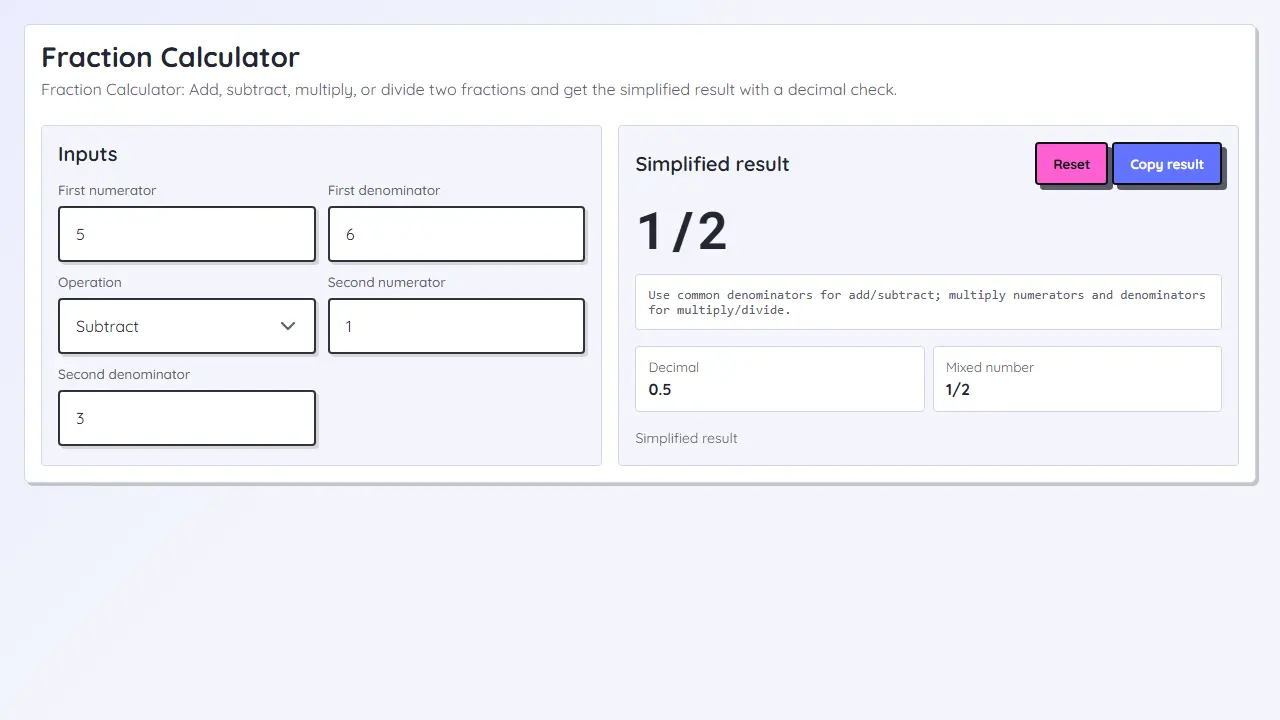
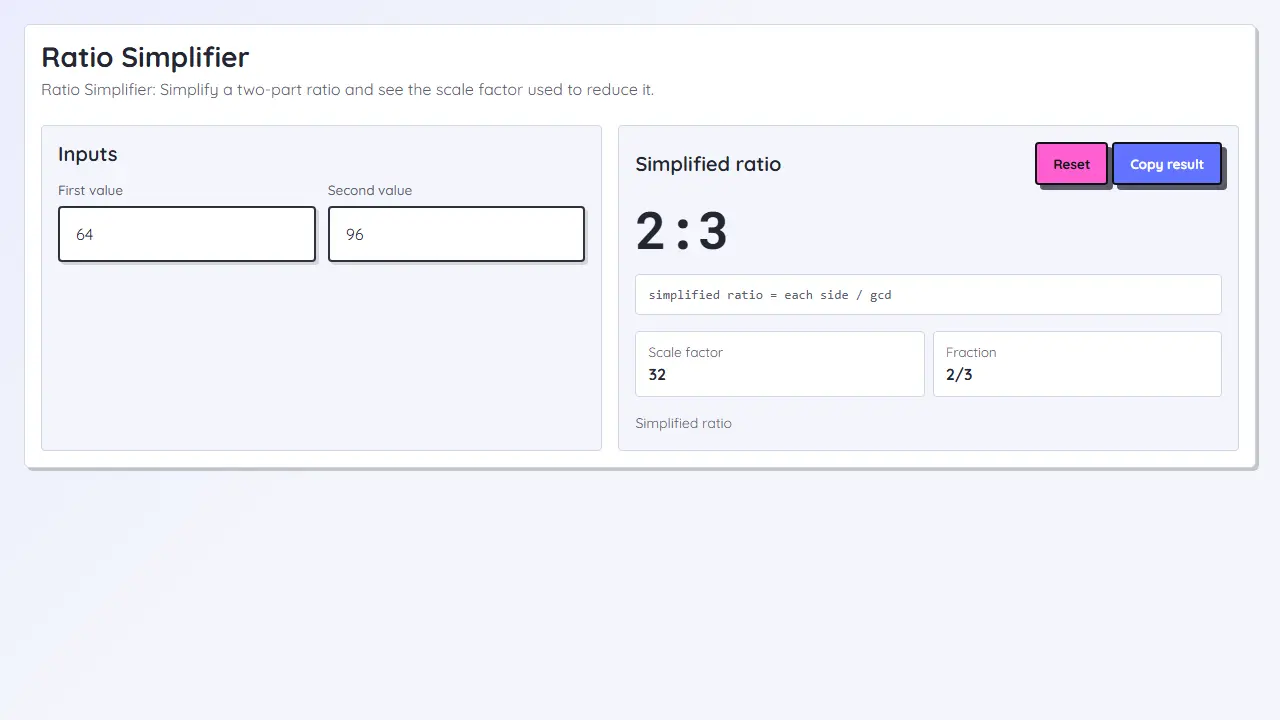
Simplify fractions into lowest terms by finding the GCD of the numerator and denominator, preserving the equivalent value, and normalizing signs.
Simplification changes the form, not the value. The greatest common divisor is computed from absolute values, then the sign is normalized so the denominator stays positive.
Loading tool...
Lowest-term form keeps the same value with the smallest whole-number parts.
The GCD measures shared size, not sign. The sign is handled after reduction so the denominator can stay positive.
It can represent the same value, but standard lowest-term form moves the negative sign to the numerator: 3/-4 becomes -3/4.