
Can a ratio have zero on one side?
Yes. 0:8 simplifies to 0:1, and 8:0 simplifies to 1:0. Both describe one side having none. 0:0 is not a meaningful comparison.
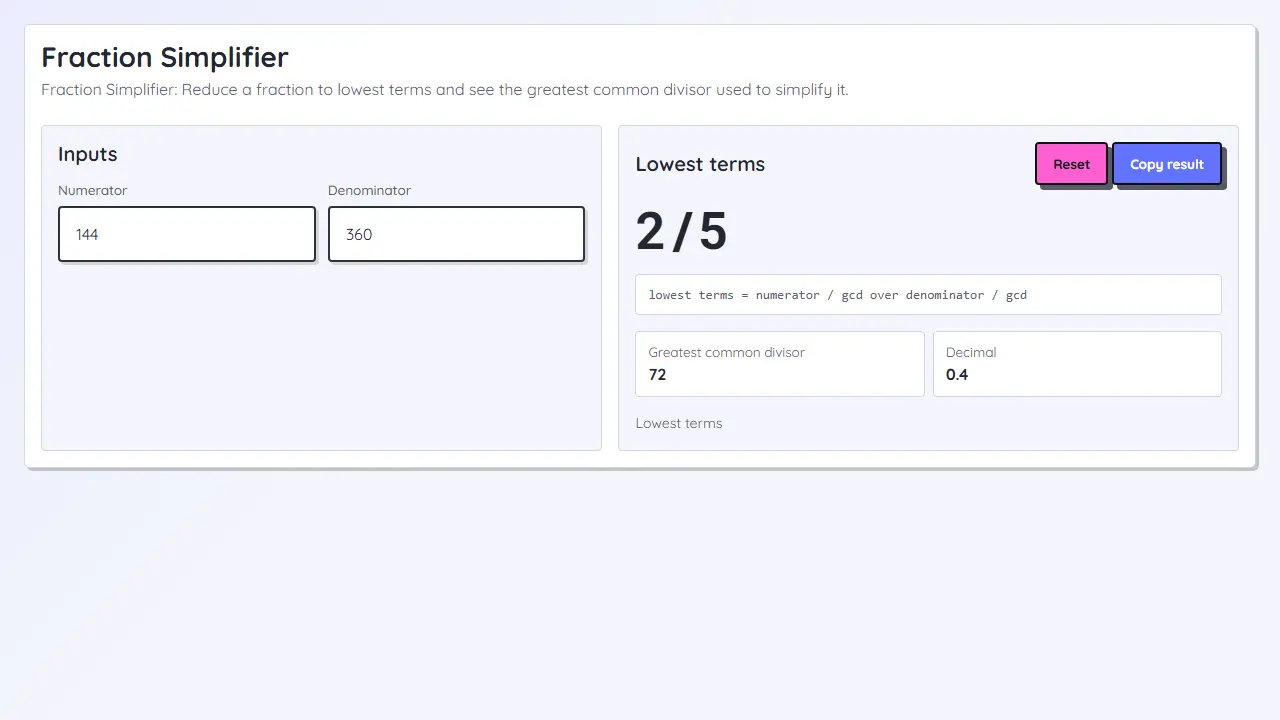
Simplify a two-part ratio by finding the greatest common divisor, dividing both sides together, and keeping the comparison meaningful.
Ratios such as 12:18, 2:3, and 20:30 can describe the same relationship. Simplifying keeps the comparison while removing shared scale.
Loading tool...
The scale factor tells how to rebuild the original ratio from the simplified one.
Yes. 0:8 simplifies to 0:1, and 8:0 simplifies to 1:0. Both describe one side having none. 0:0 is not a meaningful comparison.
Not exactly. The simplified ratio gives the smallest matching parts; the scale factor tells how many times those parts were multiplied to make the original ratio.