
Why reduce before checking whether the decimal repeats?
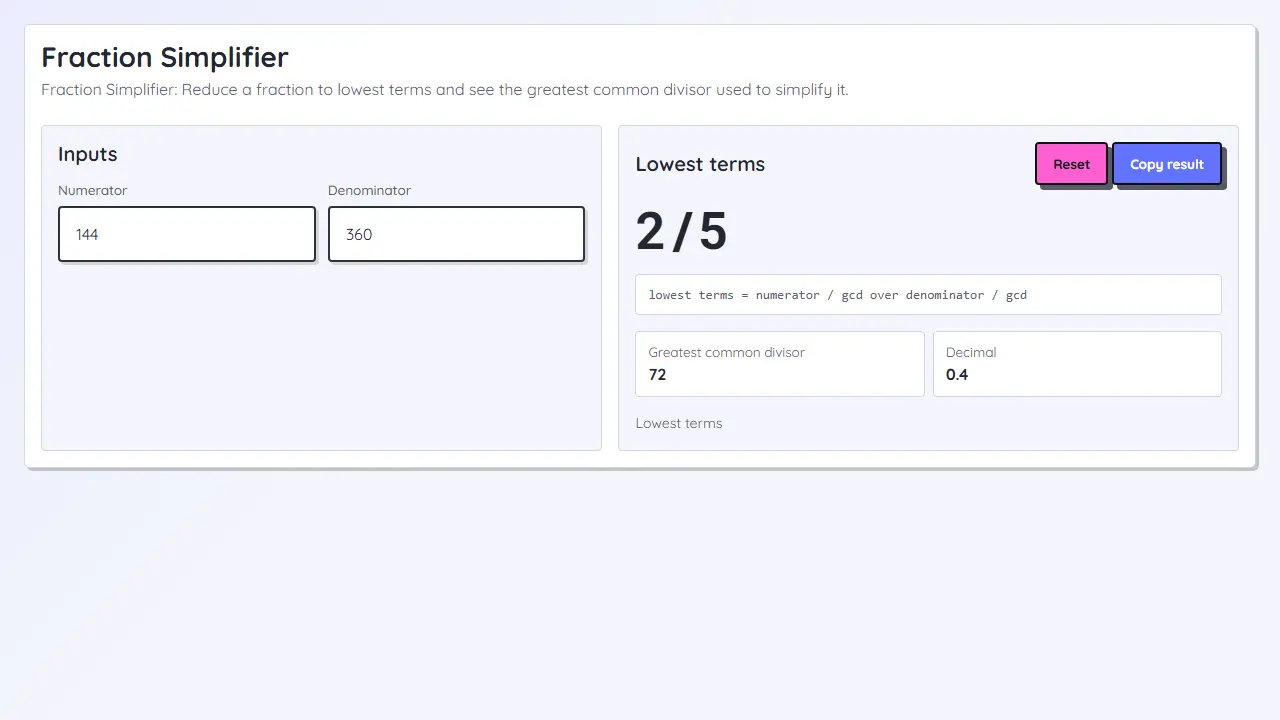
Shared factors can hide the real denominator. For example, 6/12 reduces to 1/2, so it terminates even though the original denominator is 12.
Convert a fraction by treating the fraction bar as division, then check the reduced denominator to know whether the decimal ends or repeats.
Decimal behavior depends on the reduced denominator, not necessarily the denominator you typed. After reduction, denominators made only from factors 2 and 5 terminate; every other prime factor repeats.
Loading tool...
The same fraction value can have different-looking denominators before and after reduction.
Shared factors can hide the real denominator. For example, 6/12 reduces to 1/2, so it terminates even though the original denominator is 12.
Only if the calculator marks it as exact. A rounded display is an approximation, so multiplying it back by the denominator may not return the original numerator exactly.